
We generate your legally sound data processing agreements automatically in minutes. Create them online now and download immediately.











10,000+
Happy users
40,000+
Legal documents created
1,500+
Integrated services
Capture mandatory details in a structured way – without legal jargon. Dieter guides you through the questionnaire and you receive a ready contract text to download.
Context & vendor
Who is controller, who processes on your behalf – and which data and purposes are involved?
Dieter creates your DPA
From your inputs you get a complete contract under Art. 28 GDPR with typical mandatory clauses.
Download & update
Save the contract and share with the vendor. Update easily when tools or processes change.
Legally sound for controller & processor
A solid DPA protects both sides: clear responsibilities, evidence for authorities, and less dispute in case of incidents. When a DPA is mandatory and when it is not is covered in our guide to the data processing agreement; the security measures involved are described in the article on technical and organisational measures.

As soon as an external service processes personal data on your behalf, you need a data processing agreement (DPA). That already applies when you use cloud providers or external hosting. Conversely, you also need a DPA when you process personal data for others. Almost all businesses use Google, Microsoft, Meta, Amazon, etc. – here DPAs under Art. 28 GDPR and, where relevant, international agreements (SCC/JC) are mandatory. When exactly a DPA is needed and when it is not, for example with your tax adviser, is explained in our guide to the data processing agreement.
A DPA must describe the nature and purpose of processing, categories of data and data subjects, rights and obligations of controller and processor, security measures (technical and organisational measures), sub-processing, breach notification, and deletion or return of data after processing ends. Art. 28 GDPR sets these minimum contents; templates from the internet are often incomplete or a poor fit.
Dieter guides you with simple questions (mostly yes/no or predefined choices). All mandatory details are included; contracts are tailored to your needs and can be updated when facts or law change so Art. 28 GDPR requirements stay met.
A DPA is mandatory when you engage a processor to process personal data on your behalf – e.g. hosting, cloud, CRM, newsletter tools, or tax advisers.
Without a written contract under Art. 28 GDPR you lack evidence for authorities and increase fine and liability risk.
Typical mistake
Boilerplate contracts are used unchanged but not adapted to actual processing (purposes, services, sub-processors) – that often fails scrutiny.
These topics are central in practice:
The controller determines purposes and means of processing (e.g. your company). The processor processes only on instructions – not for its own purposes.
The DPA assigns these roles clearly so everyone knows who documents, reports, and ensures compliance.
No legal background – structured guidance:
Art. 28 practice often also involves processing records, TOM, and further contracts – depending on setup.
Dieter helps you keep matching documents consistent so you have traceable evidence, not just a single contract.
Start with Dieter now and create a data processing agreement that fits your vendor, purpose, and setup.
Dieter guides you step by step through every relevant GDPR topic, explains each step in plain language and keeps content and requirements up to date. You stay on the safe side of data protection law and can get back to your actual work.
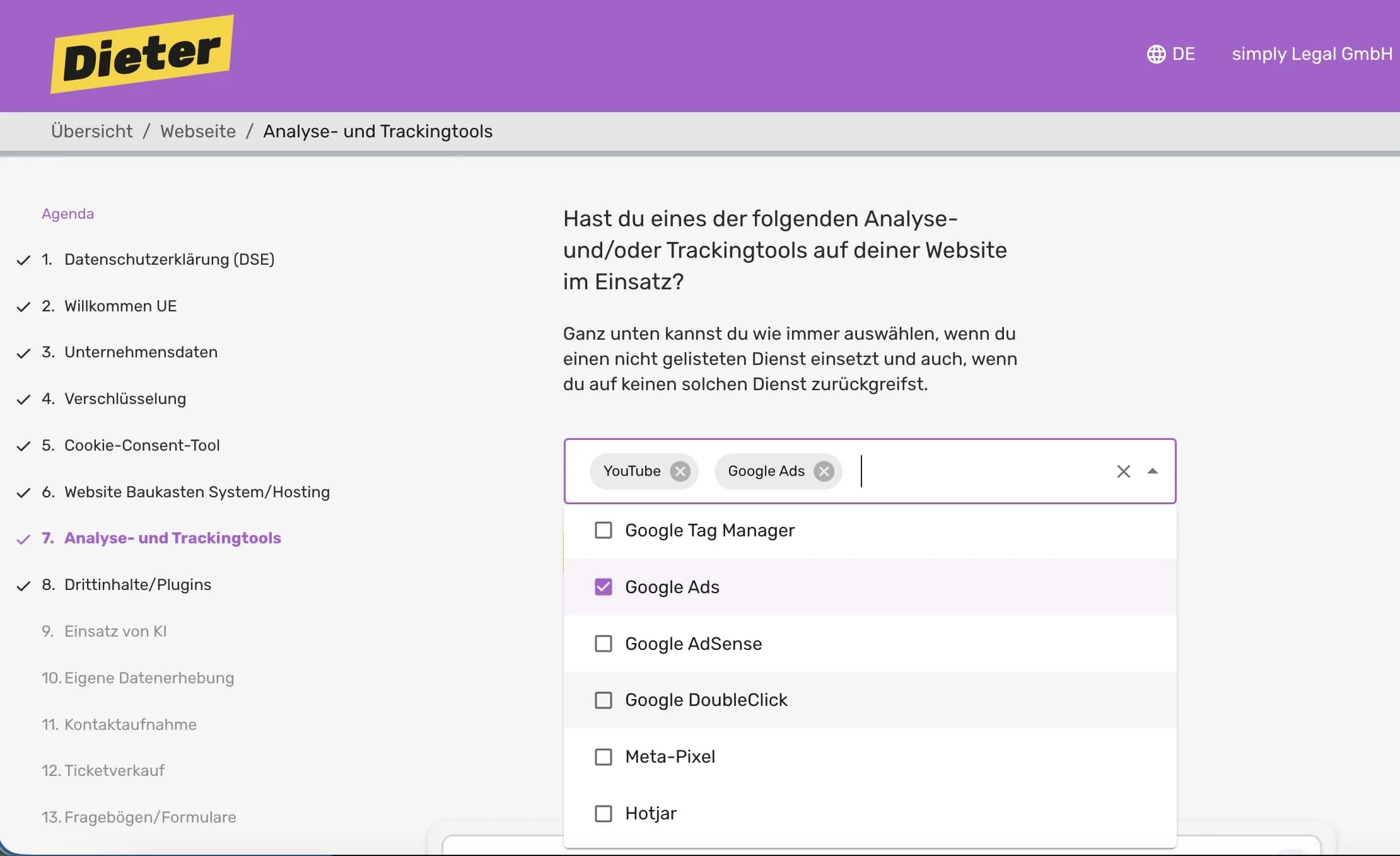
Dieter guides you through all mandatory information and turns it into a privacy policy that matches your company and your processes.
Use Cases:
Dirk
Owner at Kundegesucht
Use Cases:
Sofie
Founder at Miss Sofie's Coaching
Use Cases:
Larissa
Co-Founder at focus future
Use Cases:
Simon
Co-Founder at Dubly.AI GmbH
Use Cases:
Manuel
CEO at ALMAE Heilarbeitsinstitut GmbH
Use Cases:
Jarod
Sole proprietor at Jarod Schilke – IT Services
More reviews on OMR Reviews – Dieter and Google Reviews.
Meet our team, learn about the values and principles we work by and where we get involved.
We are a small, dedicated team of lawyers and techies working every day to make Dieter even better.
Transparency is close to our hearts and part of our DNA. In a dedicated overview we openly explain how we handle personal data – from technical measures and contracts to the services we use and your rights.
We are connected with recognised associations and initiatives in the data protection and legal tech space.



Get to know Dieter and take the first step towards a GDPR-compliant business.
A DPA is always required when service providers process personal data on your instructions. Anyone creating a data processing agreement must reliably define the subject matter, duration, data categories, TOM, sub-processors and audit rights. For businesses, the key is that the contract and the actual process reality fit together.
A good DPA is more than a PDF in the filing system. It combines vendor assessment, clear roles and traceable security requirements. Especially with internationally used tools, sub-processors and API ecosystems, a structured view of data flows is needed so that requirements are met not only formally but operationally.
In audits and enquiries, consistency counts: what the DPA says should match the record of processing activities, the privacy policy and the TOM. Linking them saves coordination, reduces contradictions and improves the quality of evidence. Businesses benefit from clearer responsibilities and a more stable data protection setup in day-to-day operations.

A compliant privacy policy and legal notice belong on every successful website. DIETER was developed by data protection officers and lawyers to back you up and support GDPR compliance.
START GDPR CHECK-UPThe AI legal advisor for SMBs that turns regulation into action.
Meet Klaus. Klaus translates the EU AI Act into clear decisions: what is allowed, what is risky, and what to do right away. Deploy AI faster while reducing liability and approval risk.