
Data protection impact assessment (DPIA) with Dieter: structured analysis, risk assessment, and documentation – with expert review of the outcome, without legal background.








10,000+
Happy users
40,000+
Legal documents created
1,500+
Integrated services
You describe planned or existing processing; Dieter supports assessment and measures – ending with an auditable document.
Processing & context
Capture purposes, data categories, data subjects, and special risks (e.g. monitoring, sensitive data, AI) in a structured way.
Risk & mitigation
Assess necessity and proportionality, name risks for data subjects, and record planned technical and organisational measures.
Documentation & expert review
DPIA as a traceable document – reviewed by our data protection experts before you use it internally or externally.
Spot high risk before it becomes critical
A DPIA is not a formal exercise: it helps you plan measures in time and convince controllers and authorities. The basis of every DPIA is an up-to-date record of processing activities and documented technical and organisational measures.

A data protection impact assessment (DPIA) is legally required when planned processing is likely to result in high risk to the rights and freedoms of data subjects (Art. 35 GDPR). That regularly applies to systematic, large-scale monitoring (e.g. video surveillance, tracking), processing of especially sensitive data (health, finances), or use of AI and automated systems — e.g. profiling, decision support, or behavioural analysis, including high-risk AI systems under the EU AI Act. The safeguards a DPIA names are explained in our guide to technical and organisational measures.
A DPIA must describe the processing and its purposes, assess necessity and proportionality, analyse risks for data subjects, and set out planned remedial measures and safeguards (technical and organisational measures). The basis for this is an up-to-date record of processing activities that already describes the processing in question. Dieter’s tool guides you through analysis, risk assessment, and documentation – structured, legally sound, and complete. Every outcome is reviewed by our experts.
No prior knowledge required: steps are predefined, evaluation is automated and digital. You meet the demanding DPIA obligation without a legal background.
A DPIA under Art. 35 GDPR is required when processing is likely to result in high risk to the rights and freedoms of data subjects – e.g. large-scale monitoring, sensitive data, or AI-supported decisions.
Especially for new tools: check before go-live whether a DPIA is needed; not only after complaints or internal questions.
Typical mistake
Products go live and risk assessment follows later. The DPIA must happen in advance so measures can take effect in time.
A robust DPIA links description, assessment, and concrete safeguards:
Creation runs in clear steps: define scope, map data flows, assess risks, define measures, and document the outcome in an audit-ready way.
With Dieter you follow this flow with guidance – including expert review so the DPIA is not only formal but substantively sound.
TOM describe protective measures generally or per processing; the DPIA goes further and checks whether high risk for data subjects remains despite those measures.
In practice you often need both: TOM as the security baseline and DPIA as in-depth risk review for especially critical processing.
When new purposes, data types, recipients, technologies, or scale appear, revise or recreate the DPIA.
That keeps evidence aligned with records, TOM, and internal decisions – and lets you argue clearly to authorities and customers.
Action prompt
Set a fixed DPIA review trigger, e.g. before every major feature release or when changing vendors.
Start now: capture processing, assess risks, plan remedial measures – and have the outcome reviewed by our experts.
Dieter guides you step by step through every relevant GDPR topic, explains each step in plain language and keeps content and requirements up to date. You stay on the safe side of data protection law and can get back to your actual work.
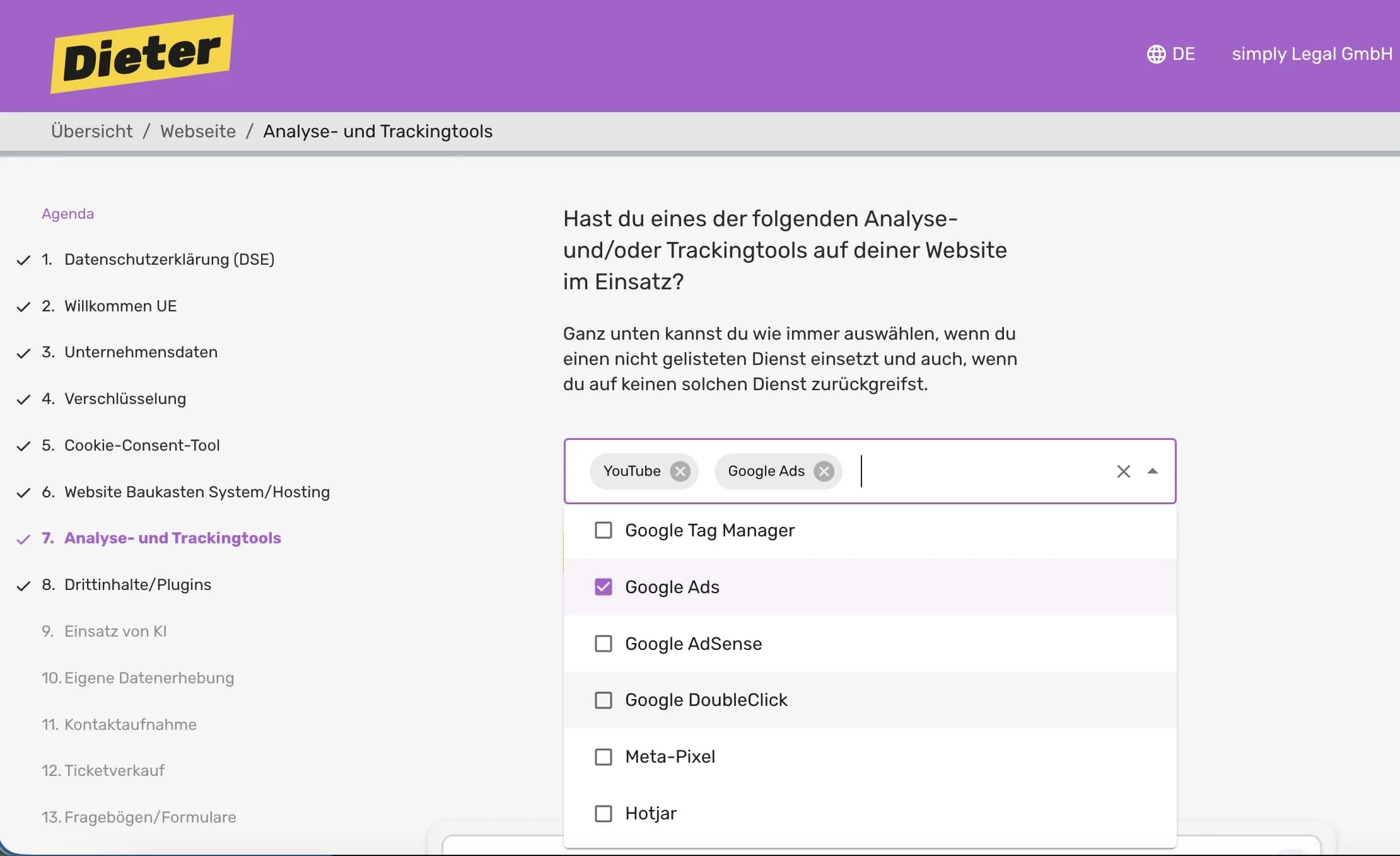
Dieter guides you through all mandatory information and turns it into a privacy policy that matches your company and your processes.
Use Cases:
Dirk
Owner at Kundegesucht
Use Cases:
Sofie
Founder at Miss Sofie's Coaching
Use Cases:
Larissa
Co-Founder at focus future
Use Cases:
Simon
Co-Founder at Dubly.AI GmbH
Use Cases:
Manuel
CEO at ALMAE Heilarbeitsinstitut GmbH
Use Cases:
Jarod
Sole proprietor at Jarod Schilke – IT Services
More reviews on OMR Reviews – Dieter and Google Reviews.
Meet our team, learn about the values and principles we work by and where we get involved.
We are a small, dedicated team of lawyers and techies working every day to make Dieter even better.
Transparency is close to our hearts and part of our DNA. In a dedicated overview we openly explain how we handle personal data – from technical measures and contracts to the services we use and your rights.
We are connected with recognised associations and initiatives in the data protection and legal tech space.


Get to know Dieter and take the first step towards a GDPR-compliant business.
A DPIA under Art. 35 GDPR is required when processing is likely to result in a high risk to data subjects. Anyone creating a data protection impact assessment should not just tick off formal requirements but explain risks, likelihood and impact transparently. It is precisely this traceability that counts in audit and approval situations.
In practice, many DPIAs fail because of inconsistent criteria and a lack of structure. A robust procedure combines the description of the processing, proportionality, risk assessment and concrete mitigating measures. The result is a document that can be managed internally and stands up to external scrutiny.
A DPIA is not an isolated artefact: new features, data sources or a change of provider alter the risk situation. Review triggers should therefore be clearly defined and results reconciled with TOM, the record of processing activities and governance processes. This improves the quality of decisions and shortens reaction times when things change.

A compliant privacy policy and legal notice belong on every successful website. DIETER was developed by data protection officers and lawyers to back you up and support GDPR compliance.
START GDPR CHECK-UPThe AI legal advisor for SMBs that turns regulation into action.
Meet Klaus. Klaus translates the EU AI Act into clear decisions: what is allowed, what is risky, and what to do right away. Deploy AI faster while reducing liability and approval risk.