
We generate your legally sound privacy policy automatically in minutes. Create it online now and embed it on your website straight away.











10,000+
Happy users
40,000+
Legal documents created
1,500+
Integrated services
No wall of text, no legal uncertainty: select the services you use, add the mandatory details and get a GDPR-compliant privacy policy right away.
Scan website
Dieter detects services automatically. You just need to accept them.
Dieter creates document
Dieter creates a complete privacy policy based on your setup.
Embed & keep up to date
Publish and update easily in Dieter when things change.
Dieter protects you from fines!
Developed by lawyers and data protection experts. For freelancers, SMBs, agencies and shops.

A successful web presence needs a legally sound privacy policy and legal notice (Impressum). The obligation comes from the GDPR: anyone who processes personal data must inform data subjects about processing details. Simply visiting a website involves forwarding or storing IP addresses – so every website is affected and Art. 13 GDPR information duties apply. Which details Art. 13 GDPR actually requires is explained in our guide to the privacy policy.
A privacy policy must comprehensively inform visitors about which data is processed and what happens to it. That includes the controller, types and purposes of data, legal basis, recipients, retention, transfers to third countries, cookies and tracking, and data subject rights. When data is not obtained directly from the data subject, Art. 14 GDPR also applies. All mandatory details with examples are covered in our guide: How to create a privacy policy. For service providers you integrate, such as newsletter or hosting providers, you also need a data processing agreement.
With Dieter, you can enter your website URL in the questionnaire — detected services are suggested for you to accept. With Dieter, simple targeted questions capture all processing on your website. Content and wording were developed and reviewed by lawyers and data protection officers. Over 1,000 services are integrated – from Google Analytics and Mailchimp to Shopify. That helps you map Art. 13 and Art. 14 GDPR structurally; missing services can be requested individually.
The GDPR check-up scanner analyses compliance gaps. The questionnaire scan prefills services for your privacy policy.
In practice it is almost always required: simply visiting your website usually involves processing personal data (e.g. IP addresses in server logs).
As soon as you use contact forms, newsletters, analytics, shops, payment providers, or social media you need a complete, fitting privacy policy.
Typical mistake
Boilerplate text is copied unchanged – but not adapted to the services you actually use. That creates gaps (and unnecessary risk).
These elements should be complete and clear:
No legal background required – clearly guided:
Choose from 1,000+ existing services or tell Dieter which service needs custom text.
Missing a service? You can request it – we add the matching text block.
Templates orient you but are rarely a perfect fit. Small differences in tools change mandatory disclosures.
A generator works modularly: you select your actual services and get matching text. That is faster, clearer, and reduces gaps.
The privacy policy should be one click away from every page – ideally via a clearly labelled footer link (“Privacy” or “Privacy policy”).
With website builders or CMS this is usually a menu/footer link. Important: do not hide it – keep it easy to find and permanently available.
Dieter creates the full privacy policy for you. You then paste the finished text on your site – or embed via API. The policy stays up to date when things change, without manual text maintenance.
Creating your privacy policy is supported by a website scanner. It automatically finds the services you use. You just accept them — and your privacy policy is done.
Dieter guides you step by step through every relevant GDPR topic, explains each step in plain language and keeps content and requirements up to date. You stay on the safe side of data protection law and can get back to your actual work.
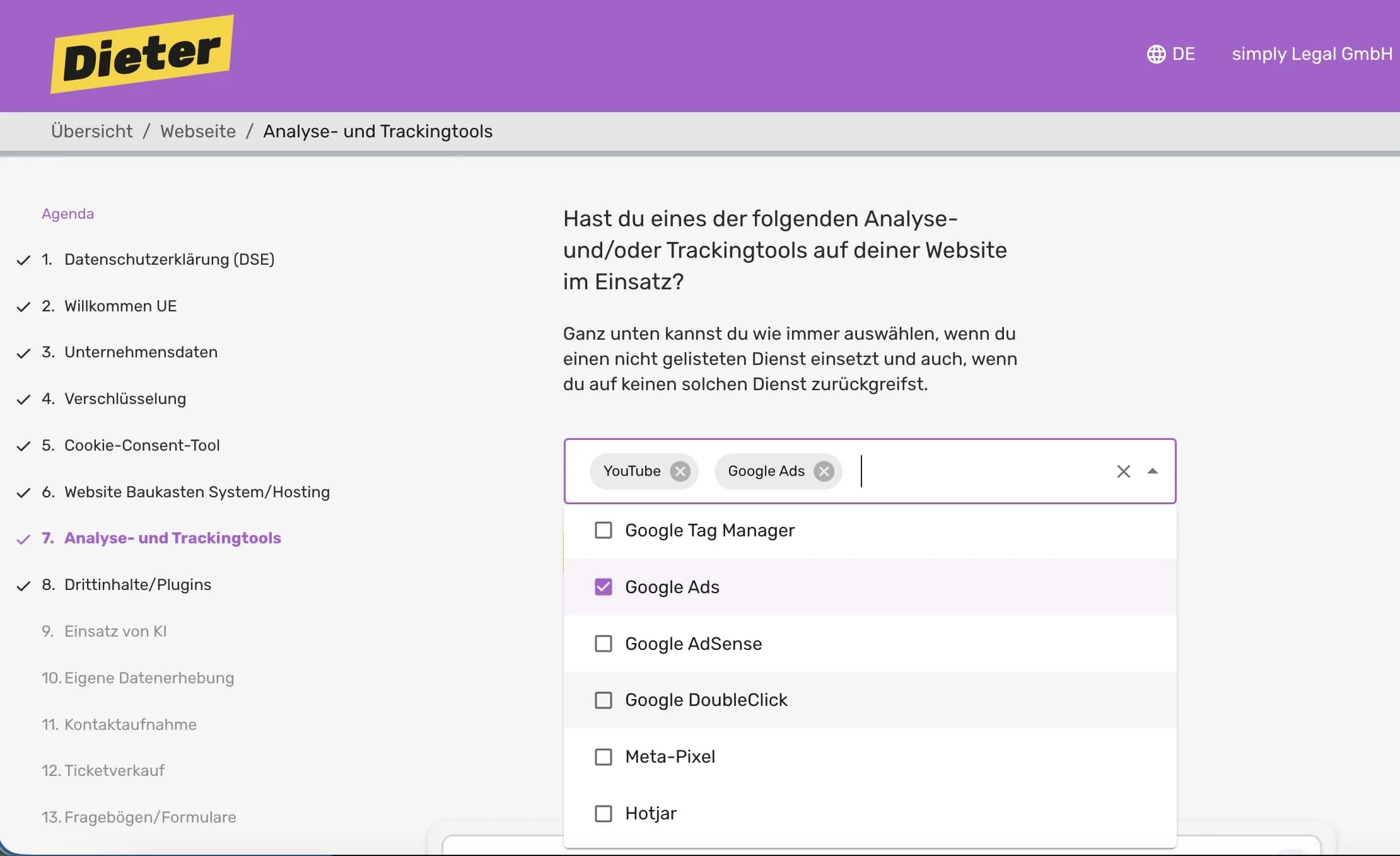
Enter your URL, review detected services, and accept them into your privacy policy with one click — without clicking through everything manually.
Use Cases:
Dirk
Owner at Kundegesucht
Use Cases:
Sofie
Founder at Miss Sofie's Coaching
Use Cases:
Larissa
Co-Founder at focus future
Use Cases:
Simon
Co-Founder at Dubly.AI GmbH
Use Cases:
Manuel
CEO at ALMAE Heilarbeitsinstitut GmbH
Use Cases:
Jarod
Sole proprietor at Jarod Schilke – IT Services
More reviews on OMR Reviews – Dieter and Google Reviews.
Meet our team, learn about the values and principles we work by and where we get involved.
We are a small, dedicated team of lawyers and techies working every day to make Dieter even better.
Transparency is close to our hearts and part of our DNA. In a dedicated overview we openly explain how we handle personal data – from technical measures and contracts to the services we use and your rights.
We are connected with recognised associations and initiatives in the data protection and legal tech space.



Get to know Dieter and take the first step towards a GDPR-compliant business.
A privacy policy only serves its purpose if it reflects real data processing. Today, people are not looking for a rigid template but for a process that cleanly brings together services, purposes, legal bases, recipients and retention periods. For reliable results, the policy must not only be complete but also clearly readable for users and consistent with how you actually operate.
Discrepancies between the website setup and the text are a common weak point: new tools, changed integrations or outdated wording lead to gaps in content. Anyone creating a privacy policy should therefore always derive it from the services and processes actually in use. This reduces the risk of enquiries, complaints and unnecessary rounds of corrections.
A good policy is not just published, it is maintained. When tracking setups, forms, integrations or service providers change, the text has to follow. Businesses that establish this cycle not only secure compliance but also build trust with customers, partners and applicants through transparency that can be traced.

A compliant privacy policy and legal notice belong on every successful website. DIETER was developed by data protection officers and lawyers to back you up and support GDPR compliance.
START GDPR CHECK-UPThe AI legal advisor for SMBs that turns regulation into action.
Meet Klaus. Klaus translates the EU AI Act into clear decisions: what is allowed, what is risky, and what to do right away. Deploy AI faster while reducing liability and approval risk.